Cianidanol suppresses M1 macrophage polarization via JAK2/STAT1 to ameliorate DNCB-induced atopic dermatitis
Chenghao Li ᵃ, Yi Shen ᵇ, Song Wu ᶜ, Changheng Zhou ᶜ, Wennuo Tan ᵈ ᵉ, Shaoyi Zhang ᵈ ᵉ ᶠ *, Heng Zhou ᶜ *
- a. School of Traditional Chinese Medicine, Faculty of Medicine, Yangzhou 225000, China
- b. School of Nursing, Faculty of Medicine, Yangzhou 225000, China
- c. School of Basic Medical Sciences & School of Public Health, Faculty of Medicine, Yangzhou University, Yangzhou 225000, China
- d. State Key Laboratory of Mechanism and Quality of Chinese Medicine, University of Macau, 999078, Macao SAR, China
- e. Centre for Immune Regulation, Institute of Chinese Medical Sciences, University of Macau, 999078, Macao SAR, China
- f. Faculty of Health Sciences, University of Macau, 999078, Macao SAR, China
研究亮点
- Cianidanol reduces epidermal hyperplasia and abnormal collagen deposition in AD.
- Cianidanol alleviates AD symptoms by suppressing pro-inflammatory M1 polarization.
- CETSA and docking validate JAK2 as a direct target of Cianidanol in regulating AD.
摘要
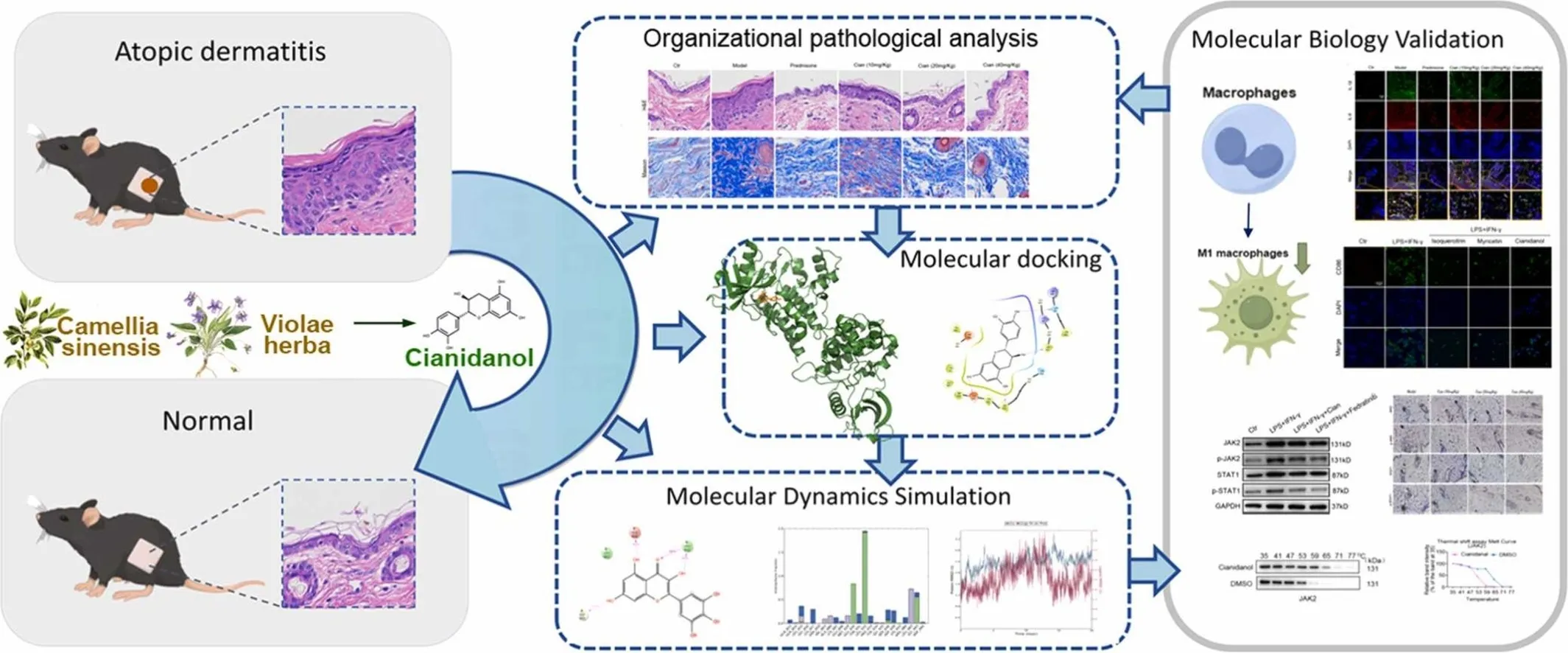
Cianidanol (Cian), also known as (+)-catechin, is a naturally occurring flavonoid found in medicinal plants including Camellia sinensis and Violae herba. Its role in inflammatory skin disease has not been well defined. Human single-cell RNA sequencing data showed an increased proportion of M1-like macrophages in atopic dermatitis (AD). We therefore evaluated Cian in a 2,4-dinitrochlorobenzene-induced AD-like dermatitis mouse model and in RAW264.7 and THP-1 macrophage models. Cian alleviated skin lesions, reduced epidermal thickening, suppressed pro-inflammatory cytokine production, and restored anti-inflammatory responses. It also reduced CD86 expression without promoting a marked M2-like phenotypic shift. Mechanistically, Cian decreased the phosphorylation of Janus kinase 2 (JAK2) and signal transducer and activator of transcription 1 (STAT1). Molecular docking, molecular dynamics simulation, and cellular thermal shift assay supported a potential interaction between Cian and JAK2 in cell lysates. These findings indicate that Cian attenuates experimental AD-like inflammation in association with reduced M1-like macrophage activation and JAK2/STAT1 signaling, while its safety and pharmacokinetic profile require further investigation.