Skip to content
Research article

Single-cell encapsulation of Agathobacter rectalis in Aloe vera gel alleviates DSS-induced colitis by remodeling the gut microbiota–metabolite axis

Jiasu Li ᵃ ¹, Xue Fang ᵃ ¹, Jie Chen ᵃ ¹, Yinggang Xu ᵇ, Zhaoshen Li ᵃ *, Yiqi Du ᵃ *, Weiliang Hou ᵃ *

Read the full article
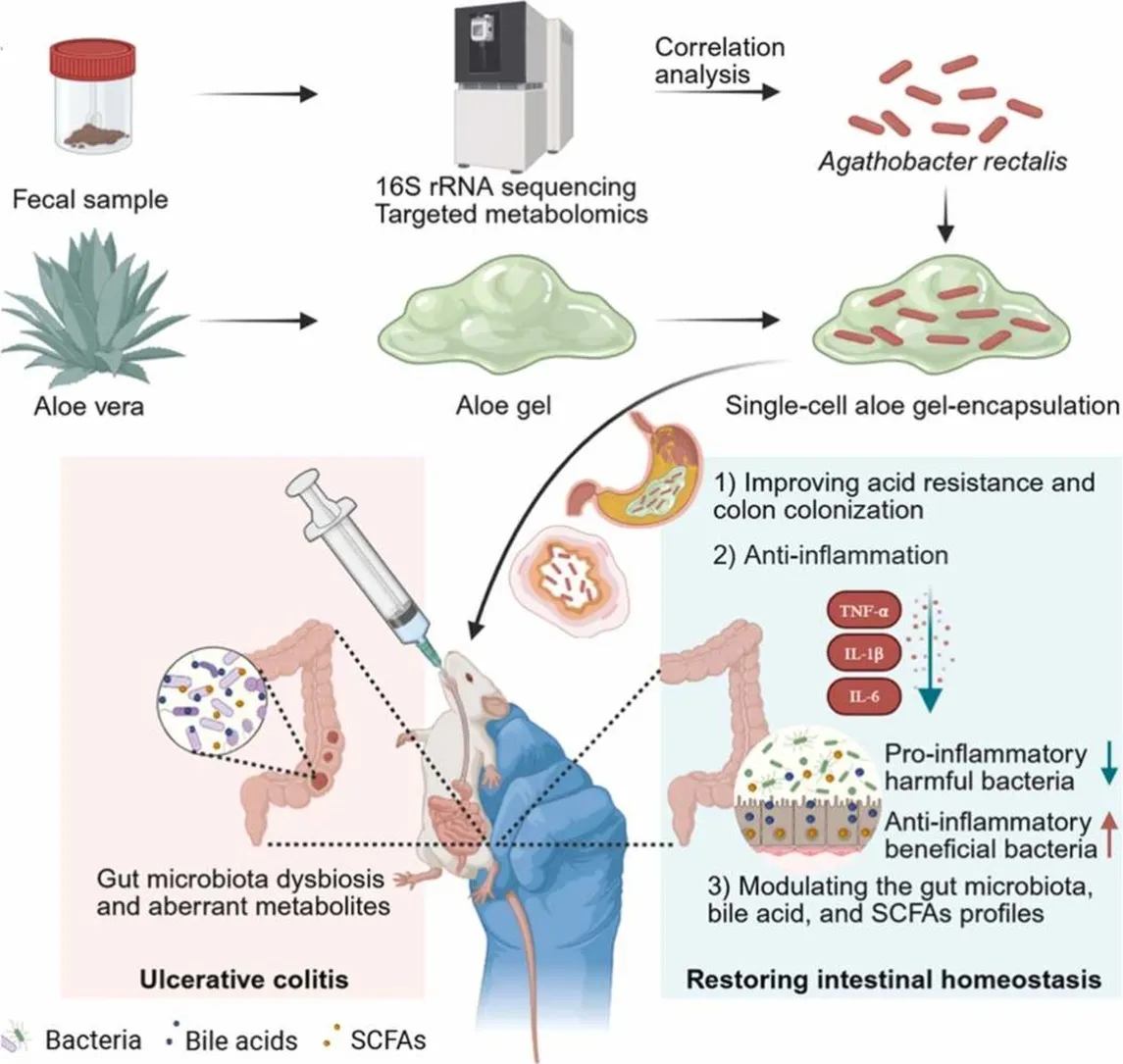
Graphical abstract — Single-cell encapsulation of Agathobacter rectalis in Aloe vera gel alleviates DSS-induced colitis by remodeling the gut microbiota–metabolite axis
Graphical abstract

Highlights

  • A. rectalis, linked to depleted secondary bile acids, was identified from IBD feces.
  • A. rectalis alleviates DSS colitis by restoring microbiota and bile acid balance.
  • Single-cell aloe gel coating (A. rectalis@Aloe) enhances gastric survival and gut colonization.
  • A. rectalis@Aloe achieves superior colitis efficacy via microbiota–metabolite remodeling.

Abstract

Gut microbiota dysbiosis and metabolic disturbances are implicated in inflammatory bowel disease (IBD). Current probiotic therapies are limited by poor bioavailability and inadequate colonic colonization. Here, we identified Agathobacter rectalis from IBD patient feces and demonstrated that it alleviated dextran sulfate sodium-induced colitis in mice by reshaping the gut microbiota and bile acid pool.

To overcome these delivery barriers, we developed a single-cell encapsulation system using Aloe vera gel, a natural acid-resistant and anti-inflammatory hydrogel, and designated it as A. rectalis@Aloe to enhance probiotic bioavailability and targeted colonic retention. Comprehensive characterization confirmed that encapsulation significantly improved bacterial viability in simulated gastric fluid and enhanced colonic colonization.

In murine colitis models, A. rectalis@Aloe synergistically suppressed inflammation, reinforced barrier function, modulated gut microbiota, and increased short-chain fatty acid production. Mechanistically, it inhibited cytokine–cytokine receptor interactions and the PI3K–Akt pathway. By synergistically enhancing gastric acid survival, mucosal colonization, and multi-pathway anti-inflammatory effects, this single-cell aloe gel encapsulation strategy offers a clinically promising and readily translatable platform for live biotherapeutics targeting the gut microbiota–metabolite axis in IBD.

Agathobacter rectalis Aloe vera gel Colitis Gut microbiota Live biotherapeutics

Affiliations

  1. a. Department of Gastroenterology, National Key Laboratory of Immunity and Inflammation, Changhai Clinical Research Unit, Changhai Hospital, Naval Medical University, Shanghai 200433, China
  2. b. Department of Emergency, Beidaihe Rest and Recuperation Center of PLA, Qinhuangdao 066199, China

More from TransMed