Skip to content
Research article

Cianidanol suppresses M1 macrophage polarization via JAK2/STAT1 to ameliorate DNCB-induced atopic dermatitis

Chenghao Li ᵃ, Yi Shen ᵇ, Song Wu ᶜ, Changheng Zhou ᶜ, Wennuo Tan ᵈ ᵉ, Shaoyi Zhang ᵈ ᵉ ᶠ *, Heng Zhou ᶜ *

Read the full article
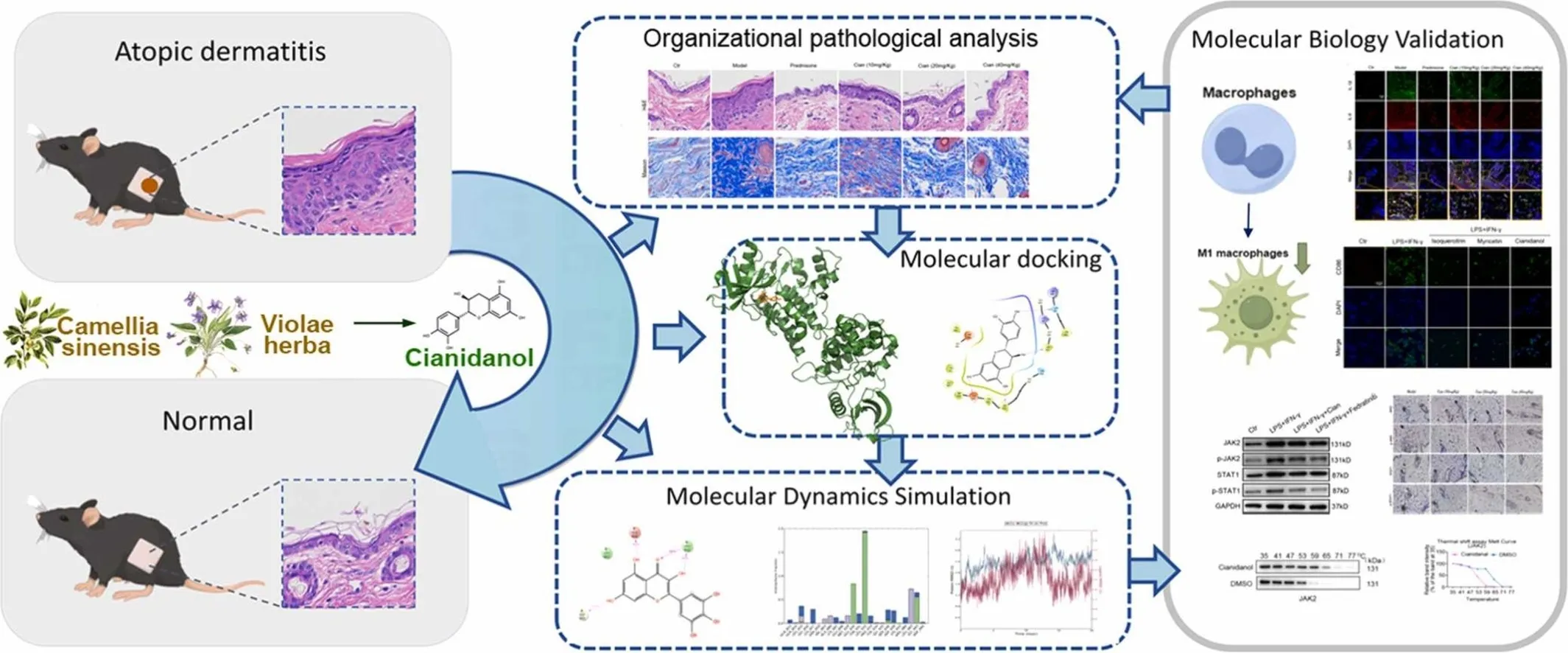
Graphical abstract — Cianidanol suppresses M1 macrophage polarization via JAK2/STAT1 to ameliorate DNCB-induced atopic dermatitis
Graphical abstract

Highlights

  • Cianidanol reduces epidermal hyperplasia and abnormal collagen deposition in AD.
  • Cianidanol alleviates AD symptoms by suppressing pro-inflammatory M1 polarization.
  • CETSA and docking validate JAK2 as a direct target of Cianidanol in regulating AD.

Abstract

Cianidanol (Cian), also known as (+)-catechin, is a naturally occurring flavonoid found in medicinal plants including Camellia sinensis and Violae herba. Its role in inflammatory skin disease has not been well defined. Human single-cell RNA sequencing data showed an increased proportion of M1-like macrophages in atopic dermatitis (AD).

We therefore evaluated Cian in a 2,4-dinitrochlorobenzene-induced AD-like dermatitis mouse model and in RAW264.7 and THP-1 macrophage models. Cian alleviated skin lesions, reduced epidermal thickening, suppressed pro-inflammatory cytokine production, and restored anti-inflammatory responses. It also reduced CD86 expression without promoting a marked M2-like phenotypic shift.

Mechanistically, Cian decreased the phosphorylation of Janus kinase 2 (JAK2) and signal transducer and activator of transcription 1 (STAT1). Molecular docking, molecular dynamics simulation, and cellular thermal shift assay supported a potential interaction between Cian and JAK2 in cell lysates. These findings indicate that Cian attenuates experimental AD-like inflammation in association with reduced M1-like macrophage activation and JAK2/STAT1 signaling, while its safety and pharmacokinetic profile require further investigation.

Cianidanol Atopic dermatitis M1 macrophage JAK2/STAT1 Inflammation

Affiliations

  1. a. School of Traditional Chinese Medicine, Faculty of Medicine, Yangzhou 225000, China
  2. b. School of Nursing, Faculty of Medicine, Yangzhou 225000, China
  3. c. School of Basic Medical Sciences & School of Public Health, Faculty of Medicine, Yangzhou University, Yangzhou 225000, China
  4. d. State Key Laboratory of Mechanism and Quality of Chinese Medicine, University of Macau, 999078, Macao SAR, China
  5. e. Centre for Immune Regulation, Institute of Chinese Medical Sciences, University of Macau, 999078, Macao SAR, China
  6. f. Faculty of Health Sciences, University of Macau, 999078, Macao SAR, China

More from TransMed